

Palavras-chave
Recém-nascido de muito baixo peso
Como Citar
Resumo
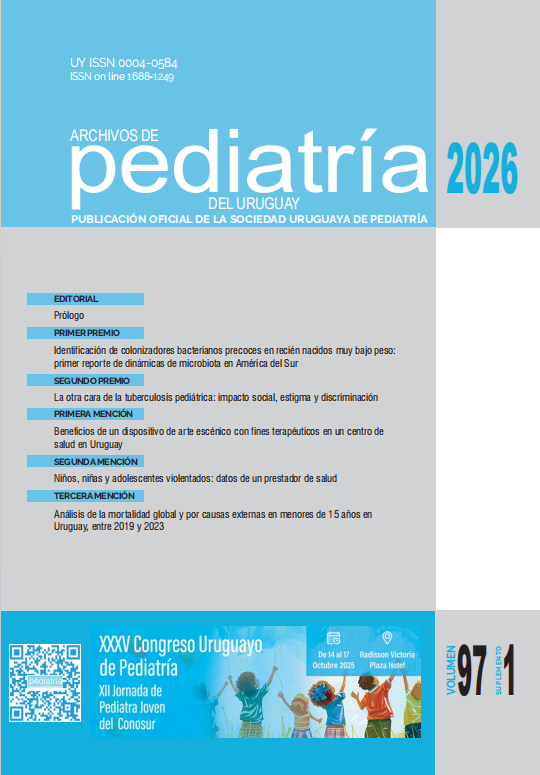
A mortalidade em recém-nascidos de muito baixo peso (RNMBP) representa até 50%-70% da mortalidade neonatal e até 25%-30% da mortalidade infantil. Apesar do aumento global nas taxas de sobrevida, esta população continua apresentando um risco elevado de desenvolver atrasos no neurodesenvolvimento a longo prazo, doença pulmonar crônica, desnutrição, deficiências visuais e auditivas. A composição microbiana intestinal dos RNMBP difere daquela dos recém-nascidos a termo e é tipicamente dominada por patobiontes. Neste estudo, caracterizamos a composição bacteriana da microbiota intestinal dos RNMBP nascidos num hospital pediátrico público de referência e terciária em Montevidéu, Uruguai, mediante o sequenciamento do gene 16S rRNA de comprimento total utilizando tecnologias Oxford Nanopore. Descrevemos uma alta predominância de Klebsiella pneumoniae e Escherichia coli nesses recém-nascidos. Ao sequenciar amostras de matéria fecal em dois momentos diferentes da hospitalização, mostramos que a diversidade da comunidade microbiana aumenta com o tempo, com uma maior abundância relativa de Bacteroides e Veillonella. Além disso, descrevemos o efeito da exposição prolongada a antibióticos na composição. Diferentes espécies do gênero Klebsiella foram observadas juntamente com Escherichia coli, Enterobacter cloacae, Citrobacter freundii e Veillonella parvula em maior abundância relativa em pacientes tratados com antibióticos por mais de cinco dias. Em conjunto, nossas descobertas lançam luz sobre o desenvolvimento e o estabelecimento de comunidades microbianas nos primeiros anos de vida na América do Sul. Nossos resultados apontam para o uso de antibióticos pós-natais como um fator importante que orquestra esse processo. Integrar considerações sobre a saúde da comunidade microbiana no cuidado clínico de bebês prematuros é crucial para melhorar o desenvolvimento a longo prazo.
Referências
Jokela R, Ponsero A, Dikareva E, Wei X, Kolho K, Korpela K, et al. Sources of gut microbiota variation in a large longitudinal Finnish infant cohort. EBioMedicine 2023; 94:104695. doi: 10.1016/j.ebiom.2023.104695.
Mitchell C, Mazzoni C, Hogstrom L, Bryant A, Bergerat A, Cher A, et al. Delivery mode affects stability of early infant gut microbiota. Cell Rep Med 2020; 1(9):100156. doi: 10.1016/j.xcrm.2020.100156.
Browne H, Shao Y, Lawley T. Mother-infant transmission of human microbiota. Curr Opin Microbiol 2022; 69:102173. doi: 10.1016/j.mib.2022.102173.
Wu X, Guo R, Fan Y, Chen S, Zheng W, Shu X, et al. Dynamic impact of delivery modes on gut microbiota in preterm infants hospitalized during the initial 4 weeks of life. Int J Med Microbiol 2024; 315:151621. doi: 10.1016/j.ijmm.2024.151621.
Zimmermann P, Curtis N. Breast milk microbiota: a review of the factors that influence composition. J Infect 2020; 81(1):17-47. doi: 10.1016/j.jinf.2020.01.023.
Collado M, Cernada M, Neu J, Pérez G, Gormaz M, Vento M. Factors influencing gastrointestinal tract and microbiota immune interaction in preterm infants. Pediatr Res 2015; 77(6):726-31. doi: 10.1038/pr.2015.54.
Thänert R, Schwartz D, Keen E, Hall C, Wang B, Shaikh N, et al. Clinical sequelae of gut microbiome development and disruption in hospitalized preterm infants. Cell Host Microbe 2024; 32(10):1822-1837.e5. doi: 10.1016/j.chom.2024.07.027.
Arboleya S, Sánchez B, Milani C, Duranti S, Solís G, Fernández N, et al. Intestinal microbiota development in preterm neonates and effect of perinatal antibiotics. J Pediatr 2015; 166(3):538-44. doi: 10.1016/j.jpeds.2014.09.041.
Tapia J, Toso A, Vaz Ferreira C, Fabres J, Musante G, Mariani G, et al. The unfinished work of neonatal very low birthweight infants quality improvement: Improving outcomes at a continental level in South America. Semin Fetal Neonatal Med 2021; 26(1):101193. doi: 10.1016/j.siny.2021.101193.
D’Apremont I, Marshall G, Musalem C, Mariani G, Musante G, Bancalari A, et al. Trends in perinatal practices and neonatal outcomes of very low birth weight infants during a 16-year period at NEOCOSUR Centers. J Pediatr 2020; 225:44-50.e1. doi: 10.1016/j.jpeds.2020.05.040.
Tapia J, Toso A, Vaz Ferreira C, Fabres J, Musante G, Mariani G, et al. The unfinished work of neonatal very low birthweight infants quality improvement: Improving outcomes at a continental level in South America. Semin Fetal Neonatal Med 2021; 26(1):101193. doi: 10.1016/j.siny.2021.101193.
Kiu R, Darby E, Alcon C, Acuna A, Camargo A, Lamberte L, et al. Impact of early life antibiotic and probiotic treatment on gut microbiome and resistome of very-low-birth-weight preterm infants. Nat Commun 2025; 16(1):7569. doi: 10.1038/s41467-025-62584-2.
La Rosa P, Warner B, Zhou Y, Weinstock G, Sodergren E, Hall C, et al. Patterned progression of bacterial populations in the premature infant gut. Proc Natl Acad Sci U S A 2014; 111(34):12522-7.
Masi A, Beck L, Perry J, Granger C, Hiorns A, Young G, et al. Human milk microbiota, oligosaccharide profiles, and infant gut microbiome in preterm infants diagnosed with necrotizing enterocolitis. Cell Rep Med 2024; 5(9):101708. doi: 10.1016/j.xcrm.2024.101708.
Wang S, Egan M, Ryan C, Boyaval P, Dempsey E, Ross R, et al. A good start in life is important-perinatal factors dictate early microbiota development and longer term maturation. FEMS Microbiol Rev 2020; 44(6):763-81. doi: 10.1093/femsre/fuaa030.
Tapiainen T, Koivusaari P, Brinkac L, Lorenzi H, Salo J, Renko M, et al. Impact of intrapartum and postnatal antibiotics on the gut microbiome and emergence of antimicrobial resistance in infants. Sci Rep 2019; 9(1):10635. doi: 10.1038/s41598-019-46964-5.
Zeissig S, Blumberg R. Life at the beginning: perturbation of the microbiota by antibiotics in early life and its role in health and disease. Nat Immunol 2014; 15(4):307-10. doi: 10.1038/ni.2847.
Stark A, Smith P, Hornik C, Zimmerman K, Hornik C, Pradeep S, et al. Medication Use in the Neonatal Intensive Care Unit and changes from 2010 to 2018. J Pediatr 2022; 240:66-71.e4. doi: 10.1016/j.jpeds.2021.08.075.
Fouhy F, Guinane C, Hussey S, Wall R, Ryan C, Dempsey E, et al. High-throughput sequencing reveals the incomplete, short-term recovery of infant gut microbiota following parenteral antibiotic treatment with ampicillin and gentamicin. Antimicrob Agents Chemother 2012; 56(11):5811-20. doi: 10.1128/AAC.00789-12.
Gibson M, Wang B, Ahmadi S, Burnham C, Tarr P, Warner B, et al. Developmental dynamics of the preterm infant gut microbiota and antibiotic resistome. Nat Microbiol 2016; 1:16024. doi: 10.1038/nmicrobiol.2016.24.
Yang R, Wang H, Chen D, Cai Q, Zhu J, Yuan S, et al. The effect of in-hospital breast milk intake on the gut microbiota of preterm infants. Clin Nutr ESPEN 2024; 60:146-55. doi: 10.1016/j.clnesp.2024.01.020.
Wroot E, Chapman J, Young G, Berrington J, Stewart C. Opportunities for microbiome-based therapeutics in preterm infants. Nat Microbiol 2025; 10(6):1263-6. doi: 10.1038/s41564-025-02010-x.
Fleiss N, Morrison C, Nascimento A, Stone D, Myers E. Improving early colostrum administration to very low birth weight infants in a level 3 neonatal intensive care unit: a quality improvement initiative. J Pediatr 2023; 260:113421. doi: 10.1016/j.jpeds.2023.113421.
Vaz Ferreira C, Silvera F. Estrategias de mejora de calidad en lactancia en recién nacidos muy bajo peso: revisión el tema. Arch Pediatr Urug 2023; 94(1):e401. doi: 31134/AP.94.1.8.
Gephart S, Newnam K. Closing the gap between recommended and actual human milk use for fragile infants: what will it take to overcome disparities? Clin Perinatol 2019; 46(1):39-50. doi: 10.1016/j.clp.2018.09.003.
Zhang T, Li H, Ma S, Cao J, Liao H, Huang Q, et al. The newest Oxford Nanopore R10.4.1 full-length 16S rRNA sequencing enables the accurate resolution of species-level microbial community profiling. Appl Environ Microbiol 2023; 89(10):e0060523. doi: 10.1128/aem.00605-23.
Huson D, Auch A, Qi J, Schuster S. MEGAN analysis of metagenomic data. Genome Res 2007; 17(3):377-86. doi: 10.1101/gr.5969107.
Matsuo Y, Komiya S, Yasumizu Y, Yasuoka Y, Mizushima K, Takagi T, et al. Full-length 16S rRNA gene amplicon analysis of human gut microbiota using MinION™ nanopore sequencing confers species-level resolution. BMC Microbiol 2021; 21(1):35. doi: 10.1186/s12866-021-02094-5.
Sim K, Shaw A, Randell P, Cox M, McClure Z, Li M, et al. Dysbiosis anticipating necrotizing enterocolitis in very premature infants. Clin Infect Dis 2015; 60(3):389-97. doi: 10.1093/cid/ciu822.
Torrazza R, Neu J. The altered gut microbiome and necrotizing enterocolitis. Clin Perinatol 2013; 40(1):93-108. doi: 10.1016/j.clp.2012.12.009.
Shao Y, García C, Clare S, Dawson N, Mu A, Adoum A, et al. Primary succession of Bifidobacteria drives pathogen resistance in neonatal microbiota assembly. Nat Microbiol 2024; 9(10):2570-82. doi: 10.1038/s41564-024-01804-9.
Coleman S, Unterhauser K, Rezaul K, Ledala N, Lesmes S, Caimano M, et al. High-resolution microbiome analysis reveals exclusionary Klebsiella species competition in preterm infants at risk for necrotizing enterocolitis. Sci Rep 2023; 13(1):7893. doi: 10.1038/s41598-023-34735-2.
Mäklin T, Thorpe H, Pöntinen A, Gladstone R, Shao Y, Pesonen M, et al. Strong pathogen competition in neonatal gut colonisation. Nat Commun 2022; 13(1):7417. doi: 10.1038/s41467-022-35178-5.
Sim K, Powell E, Cornwell E, Simon J, Shaw A. Development of the gut microbiota during early life in premature and term infants. Gut Pathog 2023; 15(1):3. doi: 10.1186/s13099-022-00529-6.
Ghosh S, Wang J, Yannie P, Ghosh S. Intestinal barrier function and metabolic/liver diseases. Liver Res 2020; 4(2):81-7. doi: 10.1016/j.livres.2020.03.002.
Ghosh S, Wang J, Yannie P, Ghosh S. Intestinal barrier dysfunction, LPS translocation, and disease development. J Endocr Soc 2020; 4(2):bvz039. doi: 10.1210/jendso/bvz039.
Vanuytsel T, Bercik P, Boeckxstaens G. Understanding neuroimmune interactions in disorders of gut-brain interaction: from functional to immune-mediated disorders. Gut 2023; 72(4):787-98. doi: 10.1136/gutjnl-2020-320633.
Hackam D, Sodhi C. Bench to bedside: new insights into the pathogenesis of necrotizing enterocolitis. Nat Rev Gastroenterol Hepatol 2022; 19(7):468-79. doi: 10.1038/s41575-022-00594-x.
Warner B, Deych E, Zhou Y, Hall C, Weinstock G, Sodergren E, et al. Gut bacteria dysbiosis and necrotising enterocolitis in very low birthweight infants: a prospective case-control study. Lancet 2016; 387(10031):1928-36. doi: 10.1016/S0140-6736(16)00081-7.
Byndloss M, Bäumler A. The germ-organ theory of non-communicable diseases. Nat Rev Microbiol 2018; 16(2):103-10. doi: 10.1038/nrmicro.2017.158.
Matthews L, Walsh B, Knutsen C, Neil J, Smyser C, Rogers C, et al. Brain growth in the NICU: critical periods of tissue-specific expansion. Pediatr Res 2018; 83(5):976-81. doi: 10.1038/pr.2018.4.
Rogers C, Smyser T, Smyser C, Shimony J, Inder T, Neil J. Regional white matter development in very preterm infants: perinatal predictors and early developmental outcomes. Pediatr Res 2016; 79(1-1):87-95. doi: 10.1038/pr.2015.172.
Wang S, Ryan C, Boyaval P, Dempsey E, Ross R, Stanton C. Maternal vertical transmission affecting early-life microbiota development. Trends Microbiol 2020; 28(1):28-45. doi: 10.1016/j.tim.2019.07.010.
Hahn W, Kim J, Song S, Park S, Kang N. The human milk oligosaccharides are not affected by pasteurization and freeze-drying. J Matern Fetal Neonatal Med 2019; 32(6):985-91. doi: 10.1080/14767058.2017.1397122.
Joosten K, Vermeulen M. Principles of feeding the preterm infant. Clin Nutr ESPEN 2024; 59:320-7. doi: 10.1016/j.clnesp.2023.12.016.

Este trabalho está licenciado sob uma licença Creative Commons Attribution 4.0 International License.
Copyright (c) 2026 Catalina Vaz Ferreira, Josefina Vera, Mario Moraes, Nadia Riera