
Keywords
Child
How to Cite
Abstract
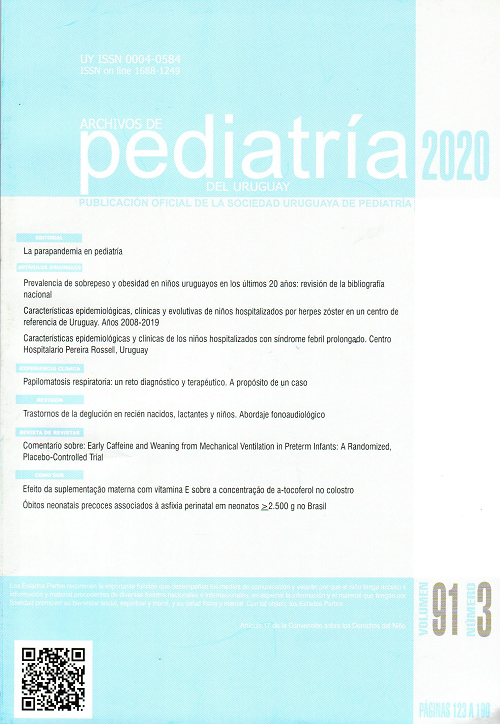
Introduction: the Prolonged Febrile Syndrome (PFS) approach is a challenge. The most frequent etiology in pediatrics is infectious.
Objective: describe the epidemiological, clinical and evolutionary characteristics of children hospitalized for PFS in a Reference Hospital Center in Uruguay between 2015 and 2019.
Materials and Methods: retrospective study of children of under 15 years of age hospitalized due to PFS. We excluded those with prolonged, recurrent fever, PFS of oncological cause and those with a previous diagnosis of autoimmune, oncological diseases or immunodeficiency. We analyzed age, fever duration, manifestations in evolution, etiology, treatment and evolution and the association between fever duration and etiology using the Wilcoxon-Mann-Whitney test (significance level 5%).
Results: 132 children were hospitalized, median age 5 years; fever median duration 9 days (8-39). During the evolution, they showed respiratory symptoms 62%, digestive symptoms 29%, general repercussion 28%. The PFS etiology was infectious 80%, viral 50% (non-specific acute respiratory infection 22), bacterial 47% (Bartonella Henselae 20) parasitic 3% (toxocariasis 2, leishmaniasis 1); autoimmune 10% (juvenile idiopathic arthritis 7); and PFS of unclear cause 10%. There was no significant association between etiology and fever duration. 72% received antimicrobials; antifungals 2%; antiviral 1%. Complication: one case of severe pharmacodermia; no deaths were recorded.
Conclusions: nonspecific viral infections were the most frequent etiology of PFS. Due to the high incidence of Epstein Barr virus infections and Bartonella Henselae, it is important to insist on their research. Most cases were benign and self-limiting.

This work is licensed under a Creative Commons Attribution 4.0 International License.
Copyright (c) 2020 Martín Notejane, Valentina Scalabrino, Maríanoel Valdez, Fiorella Cavalleri, Gustavo Giachetto