
Keywords
Factor VIII
Introns
Genetic testing
How to Cite
Abstract
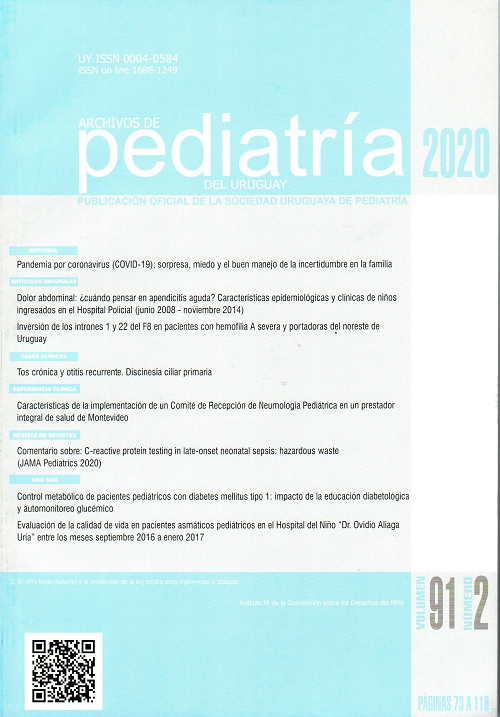
Hemophilia A (HA) is the most common X-linked coagulopathy, it is caused by mutations in the coagulation factor VIII (FVIII) gene (F8). HA can be severe when the FVIII activity is less than 1% (FVIII: C <1IU / dL). Almost a half of the severe HAs are produced by inversions of F8, the intron 1 (Inv1) and intron 22 (Inv22). Patients with severe HA show their first general bleeding between 9.7 - 10.9 months, mainly in the joints. We researched the presence of Inv1 and Inv22 in the Northeast region of Uruguay (Departments: Tacuarembó, Rivera and Cerro Largo) to estimate their frequency and detect the presence of carriers. We studied 14 individuals in 5 different families (8 patients with severe HA, 4 mothers and 2 sisters of patients). The inversion study was carried out using inverse shifting-PCR (IS-PCR) tests. Inv1 was found in 2 patients (siblings) from Tacuarembó, in their sister and mother (carriers). A patient from Rivera and his mother (carrier) were positive for Inv22. Inv1 and Inv22 are the cause of severe HA in 40% of the patients in North East of Uruguay, less than expected; however, due to the reduced population studied, Inv1 shows a considerably higher frequency than previous studies. These data enable us to characterize the genetic etiology of hemophilia, to adequately monitor patients, detect carriers, the geographical distribution of mutations and the corresponding genetic counseling for families.

This work is licensed under a Creative Commons Attribution 4.0 International License.
Copyright (c) 2020 Yasser Vega, María Faguaga, Martín Abelleyro, Carlos De Brasi, Eliane Bandinelli, Mónica Sans, Pedro Hidalgo